HBCU7/23/2026
📊 The Numbers Don't Lie: HBCUs Are Not 'Feeder Farms'—They're Becoming a Destination
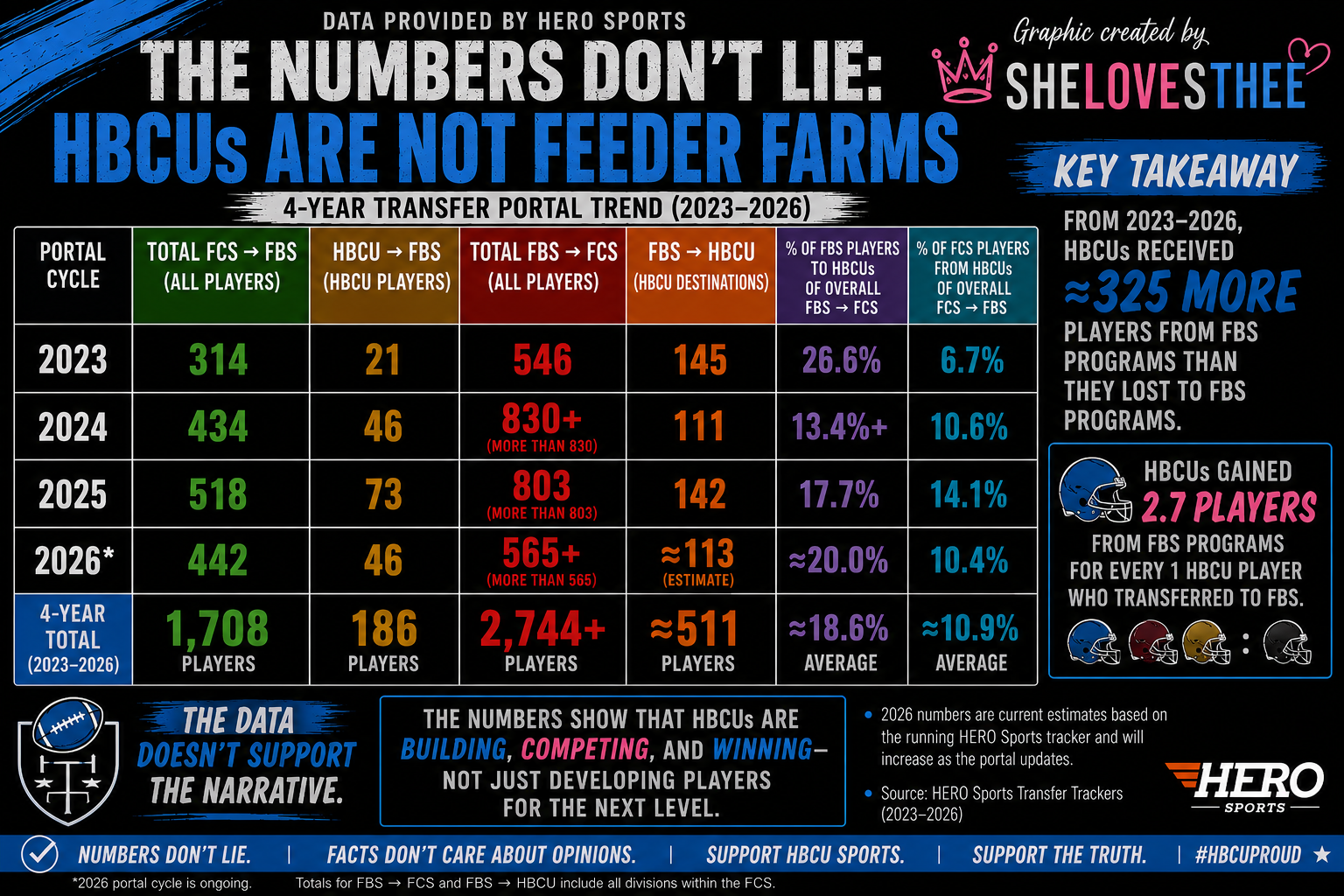
For years, the narrative has been that HBCUs are 'feeder schools' for the FBS. But when we analyzed four years of HERO Sports transfer data (2023-2026), the numbers tell a COMPLETELY different story. HBCUs have welcomed 325 MORE FBS players than they've lost.
THE NUMBERS DON'T LIE: HBCUs ARE NOT "FEEDER FARMS"
Data Provided by HERO Sports Transfer Trackers (2023–2026)
For the past several years, one of the loudest narratives surrounding HBCU football has been that HBCUs have become nothing more than "feeder farms" for the FBS.
It's a catchy talking point.
It creates debate.
It generates clicks.
But the data tells a much different story.
When we analyzed four years of HERO Sports transfer data (2023–2026), the numbers simply do not support that conclusion.
Instead, they reveal something much more significant.
HBCU football isn't declining.
It's evolving.
It's adapting.
And in many ways, it's experiencing a resurgence.
---
📈 The Numbers Tell a Different Story
Over the last four transfer portal cycles:
| Direction | Players |
|-----------|---------|
| HBCU → FBS | 186 |
| FBS → HBCU | ~511 |
That means HBCUs have welcomed approximately:
325 MORE FBS PLAYERS THAN THEY HAVE LOST TO THE FBS
The percentages become even more revealing:
- Across all FCS players transferring to the FBS, only 10.9% came from HBCUs.
- Meanwhile, approximately 18.6% of every FBS player transferring down to the FCS chose an HBCU destination.
Simply put...
More FBS players are choosing HBCUs than HBCU players are leaving for the FBS.
That isn't the profile of a "feeder farm."
---
🔍 Understanding the Data
Like all statistics, transfer portal numbers require context.
Looking only at the number of players leaving HBCUs ignores the reasons behind player movement and fails to recognize what is happening across the entire college football landscape.
Coaching Changes Create Mass Player Movement
One of the largest drivers of transfers isn't NIL.
It isn't recruiting.
It's coaching turnover.
Whenever a head coach leaves for another job or is fired, entire rosters often enter the transfer portal.
- Players committed to coaches.
- Players committed to offensive and defensive systems.
- Players committed to relationships.
When those disappear, players naturally begin exploring other opportunities.
We've seen this happen across the SEC, Big Ten, ACC, Big 12, Group of Five conferences, the FCS, and HBCU football.
This isn't unique to HBCUs. It's college football.
The Transfer Portal Changed Everything
College football today is vastly different than it was just five years ago.
- Following COVID eligibility, athletes received additional years of eligibility.
- Then came the one-time transfer rule.
- Then additional legal decisions further expanded player mobility.
The result? College football entered an era of unprecedented movement.
Players now transfer:
- More frequently
- Earlier in their careers
- Multiple times during their eligibility
Roster continuity simply isn't what it once was.
The 105-Player Roster Limit Changed Everything
Perhaps the biggest reason we've seen an explosion of FBS-to-FCS transfers over the last two portal cycles has nothing to do with HBCUs.
It has everything to do with college football's new roster structure.
Beginning with schools that opted into the House settlement, football programs moved to a 105-player roster limit. Programs that previously carried large walk-on groups and developmental players had to make difficult roster decisions.
For years, many FBS schools accumulated talent by carrying large numbers of developmental players who rarely saw the field.
That model has changed.
Schools can no longer simply stockpile talent on the bench.
As a result, hundreds of talented players entered the transfer portal looking for opportunities to play elsewhere.
Those athletes had to find new homes. Many chose HBCUs.
This wasn't an HBCU problem.
It was an FBS roster management issue.
 ---
⚠️ The Data Has Important Limitations
Transfer trackers count transfers. They do not track careers.
For example, a player can transfer:
FBS → HBCU → FBS
That player counts once entering HBCU football. Later, he counts again leaving HBCU football. Those are two completely different transactions.
One example is Antonio Doyle, who transferred from the FBS into HBCU football before eventually returning to the FBS.
Likewise, graduate transfers deserve context.
Players like Devonta Davis of Jackson State spent their undergraduate careers developing at an HBCU before transferring as graduate students.
Counting a graduate transfer the same as a sophomore leaving after one season paints an incomplete picture.
Development matters.
Career progression matters.
Context matters.
---
🏆 HBCUs Have Become Attractive Destinations
This is perhaps the most overlooked part of the conversation.
Highly recruited athletes who began their careers at Power Four and Group of Five schools are now choosing HBCUs.
Not because they failed. Because they found opportunity.
Today's HBCUs offer:
| What HBCUs Provide |
|--------------------|
| ✅ Immediate playing opportunities |
| ✅ Championship-caliber football |
| ✅ NIL opportunities |
| ✅ National television exposure |
| ✅ NFL development |
| ✅ Elite coaching |
| ✅ Strong alumni networks |
| ✅ Historic traditions |
| ✅ Culture unlike anywhere else in college football |
The transfer portal isn't simply taking talent away. It's bringing talent into HBCU football.
---
⚠️ The Data Has Important Limitations
Transfer trackers count transfers. They do not track careers.
For example, a player can transfer:
FBS → HBCU → FBS
That player counts once entering HBCU football. Later, he counts again leaving HBCU football. Those are two completely different transactions.
One example is Antonio Doyle, who transferred from the FBS into HBCU football before eventually returning to the FBS.
Likewise, graduate transfers deserve context.
Players like Devonta Davis of Jackson State spent their undergraduate careers developing at an HBCU before transferring as graduate students.
Counting a graduate transfer the same as a sophomore leaving after one season paints an incomplete picture.
Development matters.
Career progression matters.
Context matters.
---
🏆 HBCUs Have Become Attractive Destinations
This is perhaps the most overlooked part of the conversation.
Highly recruited athletes who began their careers at Power Four and Group of Five schools are now choosing HBCUs.
Not because they failed. Because they found opportunity.
Today's HBCUs offer:
| What HBCUs Provide |
|--------------------|
| ✅ Immediate playing opportunities |
| ✅ Championship-caliber football |
| ✅ NIL opportunities |
| ✅ National television exposure |
| ✅ NFL development |
| ✅ Elite coaching |
| ✅ Strong alumni networks |
| ✅ Historic traditions |
| ✅ Culture unlike anywhere else in college football |
The transfer portal isn't simply taking talent away. It's bringing talent into HBCU football.
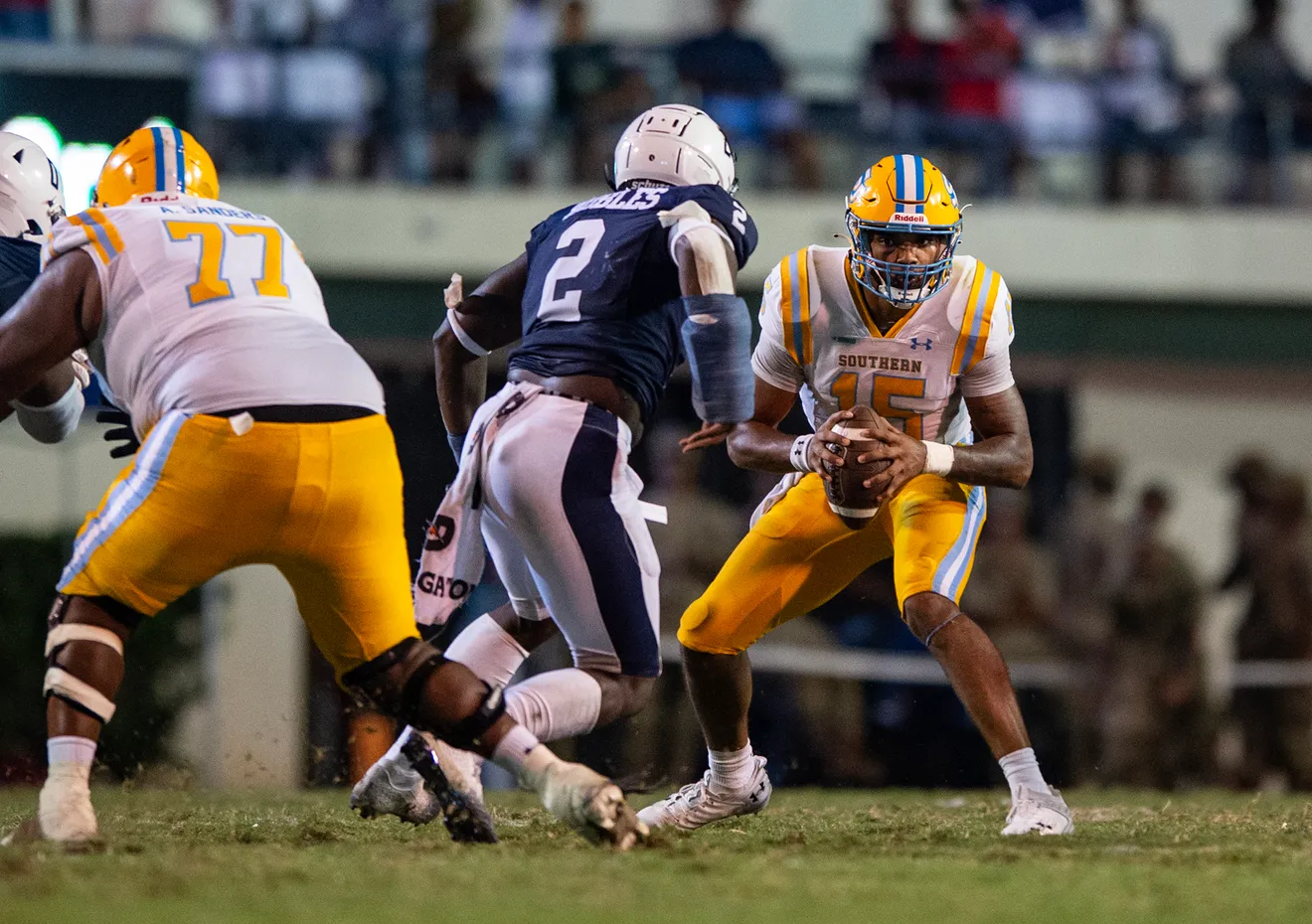 Southern University Jaguars in action - the culture of HBCU football is unmatched.
---
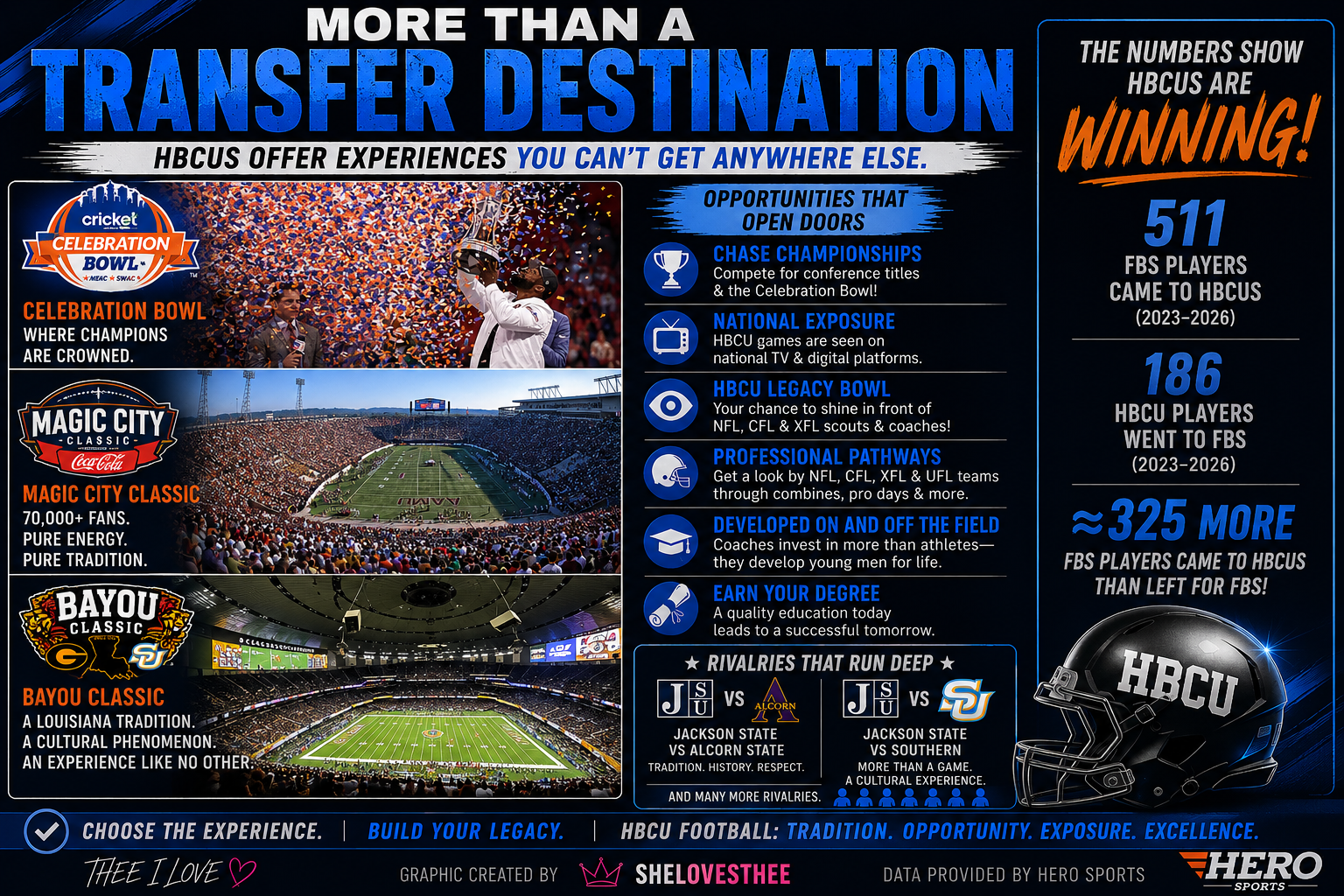
🎭 More Than a Transfer Destination
HBCUs offer experiences that simply cannot be duplicated elsewhere.
- Where else can student-athletes compete in front of 70,000+ fans at the Magic City Classic?
- Where else can they experience the pageantry and history of the Bayou Classic inside the Caesars Superdome?
- Where else can they compete for an HBCU National Championship in the Celebration Bowl?
Where else can they become part of legendary rivalries like:
| Historic HBCU Rivalries |
|-------------------------|
| 🔥 Jackson State vs Alcorn State |
| 🔥 Jackson State vs Southern |
| 🔥 Florida A&M vs Bethune-Cookman |
| 🔥 Alabama State vs Alabama A&M |
| 🔥 North Carolina Central vs North Carolina A&T |
These aren't simply football games.
They're cultural celebrations.
Family reunions.
National showcases.
Historic traditions.
Experiences many student-athletes dream of.
---
🏈 The HBCU Legacy Bowl Opens Doors
Another unique opportunity available to HBCU student-athletes is the HBCU Legacy Bowl.
Every year NFL personnel, CFL scouts, UFL representatives, professional coaches, and player personnel departments gather to evaluate HBCU talent.
The game has become another important evaluation platform that continues to produce professional opportunities.
For many athletes, HBCUs now offer multiple pathways to professional football.
---
🏟️ Professional Opportunities Continue to Grow
The narrative often suggests players must leave HBCUs to receive professional exposure.
That simply isn't true.
Today's HBCU athletes are routinely evaluated through:
- NFL Pro Days
- HBCU Combine
- HBCU Legacy Bowl
- NFL scouting departments
- CFL scouting departments
- UFL opportunities
- Professional showcases
The path to professional football has never been more accessible for HBCU athletes.
---
🎓 Developing Young Men
Football is only part of the mission.
The greatest HBCU coaches understand they are developing men.
Student-athletes:
- Earn degrees
- Build lifelong relationships
- Develop leadership skills
- Become fathers
- Business owners
- Teachers
- Coaches
- Community leaders
The degree remains one of the most valuable outcomes an HBCU can provide.
---
🔄 The Narrative Is Actually the Opposite
For years we've heard:
"HBCUs are feeder schools."
The numbers don't support it.
In fact... the exact opposite appears to be happening.
- HBCU football is becoming increasingly attractive to former FBS players.
- Experienced players are transferring into HBCU football.
- Highly touted recruits who originally signed with Power Four programs are now choosing HBCUs.
- Programs across the country are becoming destinations—not stepping stones.
This is a resurgence. A renewal. A movement.
---
⚡ Why Harmful Narratives Matter
Recruiting is built on perception.
When coaches, media personalities, and fans repeatedly label HBCUs as "feeder schools," that message reaches recruits and families.
It minimizes everything HBCUs provide:
- Culture
- Tradition
- Championship opportunities
- Education
- Professional development
- Exposure
The question shouldn't simply be:
"How many players transferred?"
The better question is: How many players did your program develop?
If someone argues athletes should avoid HBCUs because players eventually transfer, it's fair to ask:
- How many players has your program developed into Power Four opportunities?
- How many reached the NFL?
- How many graduated?
- How many maximized their careers?
Development—not narratives—is what ultimately matters.
---
🔮 The Future of the Transfer Portal
As college athletics continues to evolve, transfer portal rules remain an active topic of discussion. Additional changes to transfer windows, roster management, and eligibility could reshape player movement in the coming years.
That makes it even more important for HBCUs to control their own narrative.
Instead of allowing the conversation to focus solely on players who leave, HBCUs should highlight everything they uniquely offer.
---
📊 The Bottom Line
The transfer portal changed college football.
COVID eligibility changed college football.
Unlimited transfer flexibility changed college football.
The 105-player roster limit changed college football.
Every level of the sport has experienced unprecedented roster turnover.
Yet despite all of those changes, one fact remains clear:
Over the last four transfer cycles:
| Stat | Number |
|------|--------|
| FBS players transferred INTO HBCUs | ~511 |
| HBCU players transferred to FBS | 186 |
| NET GAIN FOR HBCUs | +325 PLAYERS |
The data doesn't support the "feeder farm" narrative.
It supports something much bigger.
HBCU football is:
- Attracting talent.
- Developing talent.
- Winning championships.
- Producing professionals.
- Providing life-changing educational opportunities.
- Celebrating traditions that cannot be replicated anywhere else in college athletics.
---
The story of HBCU football isn't one of decline.
It's one of RESURGENCE.
It's one of RENEWAL.
And the numbers prove it.
---
📈 Interactive Transfer Dashboard
Explore the data yourself! Our interactive dashboard lets you filter by year, view HBCU-specific data, switch between line and bar charts, and download the data.
Dashboard features: Year filters, HBCU/Overall/Percentage views, Line/Bar chart switching, CSV & PNG downloads
---
DATA SOURCES:
Southern University Jaguars in action - the culture of HBCU football is unmatched.
---
🎭 More Than a Transfer Destination
HBCUs offer experiences that simply cannot be duplicated elsewhere.
- Where else can student-athletes compete in front of 70,000+ fans at the Magic City Classic?
- Where else can they experience the pageantry and history of the Bayou Classic inside the Caesars Superdome?
- Where else can they compete for an HBCU National Championship in the Celebration Bowl?
Where else can they become part of legendary rivalries like:
| Historic HBCU Rivalries |
|-------------------------|
| 🔥 Jackson State vs Alcorn State |
| 🔥 Jackson State vs Southern |
| 🔥 Florida A&M vs Bethune-Cookman |
| 🔥 Alabama State vs Alabama A&M |
| 🔥 North Carolina Central vs North Carolina A&T |
These aren't simply football games.
They're cultural celebrations.
Family reunions.
National showcases.
Historic traditions.
Experiences many student-athletes dream of.
---
🏈 The HBCU Legacy Bowl Opens Doors
Another unique opportunity available to HBCU student-athletes is the HBCU Legacy Bowl.
Every year NFL personnel, CFL scouts, UFL representatives, professional coaches, and player personnel departments gather to evaluate HBCU talent.
The game has become another important evaluation platform that continues to produce professional opportunities.
For many athletes, HBCUs now offer multiple pathways to professional football.
---
🏟️ Professional Opportunities Continue to Grow
The narrative often suggests players must leave HBCUs to receive professional exposure.
That simply isn't true.
Today's HBCU athletes are routinely evaluated through:
- NFL Pro Days
- HBCU Combine
- HBCU Legacy Bowl
- NFL scouting departments
- CFL scouting departments
- UFL opportunities
- Professional showcases
The path to professional football has never been more accessible for HBCU athletes.
---
🎓 Developing Young Men
Football is only part of the mission.
The greatest HBCU coaches understand they are developing men.
Student-athletes:
- Earn degrees
- Build lifelong relationships
- Develop leadership skills
- Become fathers
- Business owners
- Teachers
- Coaches
- Community leaders
The degree remains one of the most valuable outcomes an HBCU can provide.
---
🔄 The Narrative Is Actually the Opposite
For years we've heard:
"HBCUs are feeder schools."
The numbers don't support it.
In fact... the exact opposite appears to be happening.
- HBCU football is becoming increasingly attractive to former FBS players.
- Experienced players are transferring into HBCU football.
- Highly touted recruits who originally signed with Power Four programs are now choosing HBCUs.
- Programs across the country are becoming destinations—not stepping stones.
This is a resurgence. A renewal. A movement.
---
⚡ Why Harmful Narratives Matter
Recruiting is built on perception.
When coaches, media personalities, and fans repeatedly label HBCUs as "feeder schools," that message reaches recruits and families.
It minimizes everything HBCUs provide:
- Culture
- Tradition
- Championship opportunities
- Education
- Professional development
- Exposure
The question shouldn't simply be:
"How many players transferred?"
The better question is: How many players did your program develop?
If someone argues athletes should avoid HBCUs because players eventually transfer, it's fair to ask:
- How many players has your program developed into Power Four opportunities?
- How many reached the NFL?
- How many graduated?
- How many maximized their careers?
Development—not narratives—is what ultimately matters.
---
🔮 The Future of the Transfer Portal
As college athletics continues to evolve, transfer portal rules remain an active topic of discussion. Additional changes to transfer windows, roster management, and eligibility could reshape player movement in the coming years.
That makes it even more important for HBCUs to control their own narrative.
Instead of allowing the conversation to focus solely on players who leave, HBCUs should highlight everything they uniquely offer.
---
📊 The Bottom Line
The transfer portal changed college football.
COVID eligibility changed college football.
Unlimited transfer flexibility changed college football.
The 105-player roster limit changed college football.
Every level of the sport has experienced unprecedented roster turnover.
Yet despite all of those changes, one fact remains clear:
Over the last four transfer cycles:
| Stat | Number |
|------|--------|
| FBS players transferred INTO HBCUs | ~511 |
| HBCU players transferred to FBS | 186 |
| NET GAIN FOR HBCUs | +325 PLAYERS |
The data doesn't support the "feeder farm" narrative.
It supports something much bigger.
HBCU football is:
- Attracting talent.
- Developing talent.
- Winning championships.
- Producing professionals.
- Providing life-changing educational opportunities.
- Celebrating traditions that cannot be replicated anywhere else in college athletics.
---
The story of HBCU football isn't one of decline.
It's one of RESURGENCE.
It's one of RENEWAL.
And the numbers prove it.
---
📈 Interactive Transfer Dashboard
Explore the data yourself! Our interactive dashboard lets you filter by year, view HBCU-specific data, switch between line and bar charts, and download the data.
Dashboard features: Year filters, HBCU/Overall/Percentage views, Line/Bar chart switching, CSV & PNG downloads
---
DATA SOURCES:
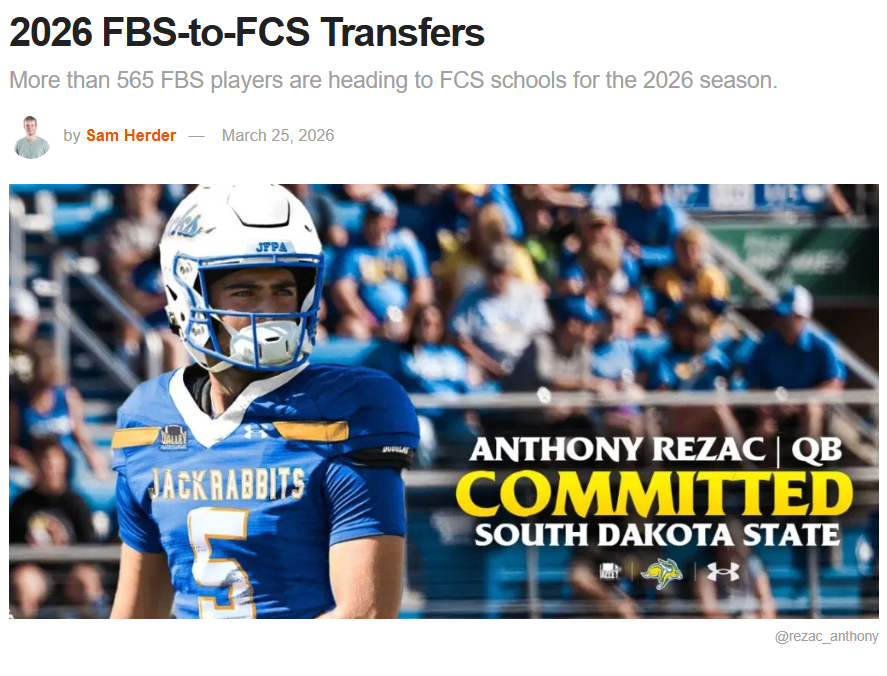 • HERO Sports - 2026 FBS to FCS Transfers
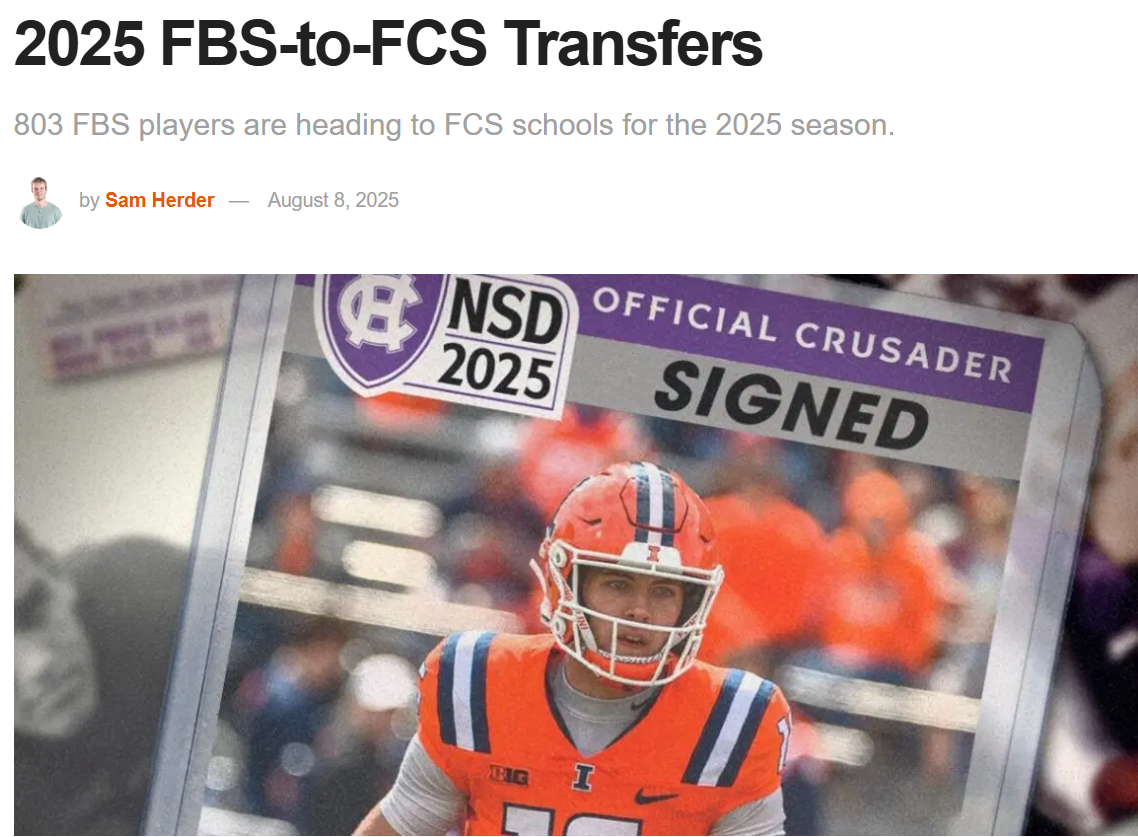 • HERO Sports - 2025 FBS to FCS Transfers
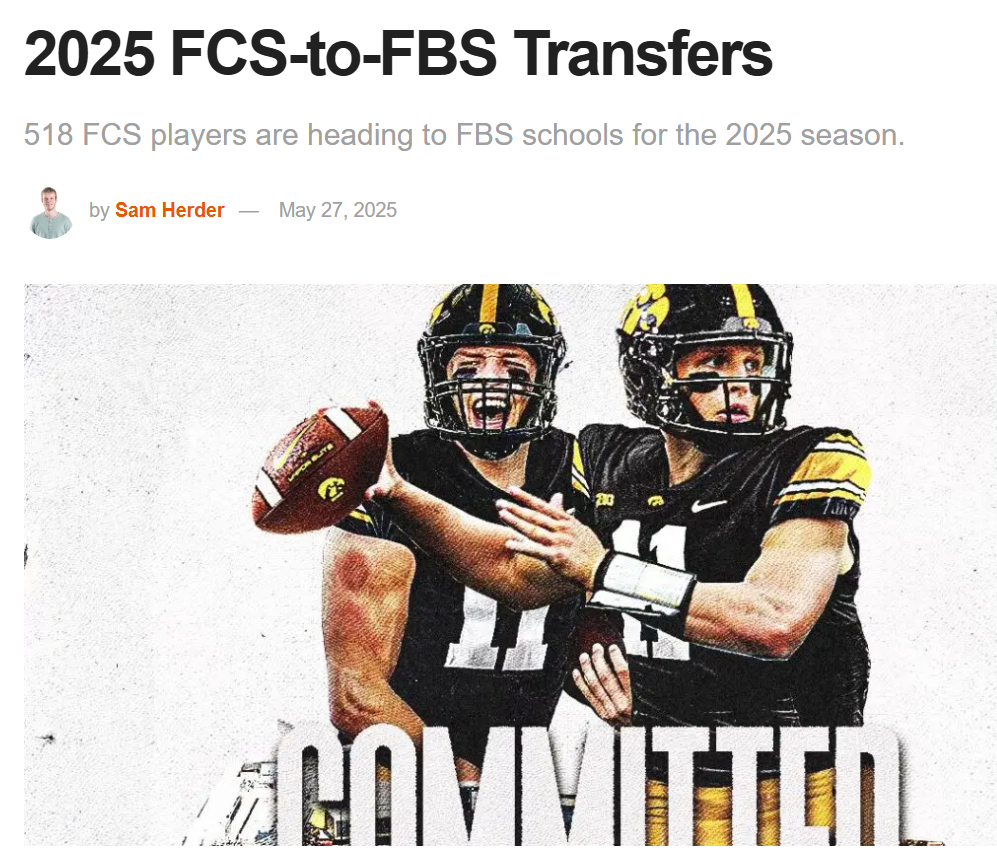 • HERO Sports - 2025 FCS to FBS Transfers
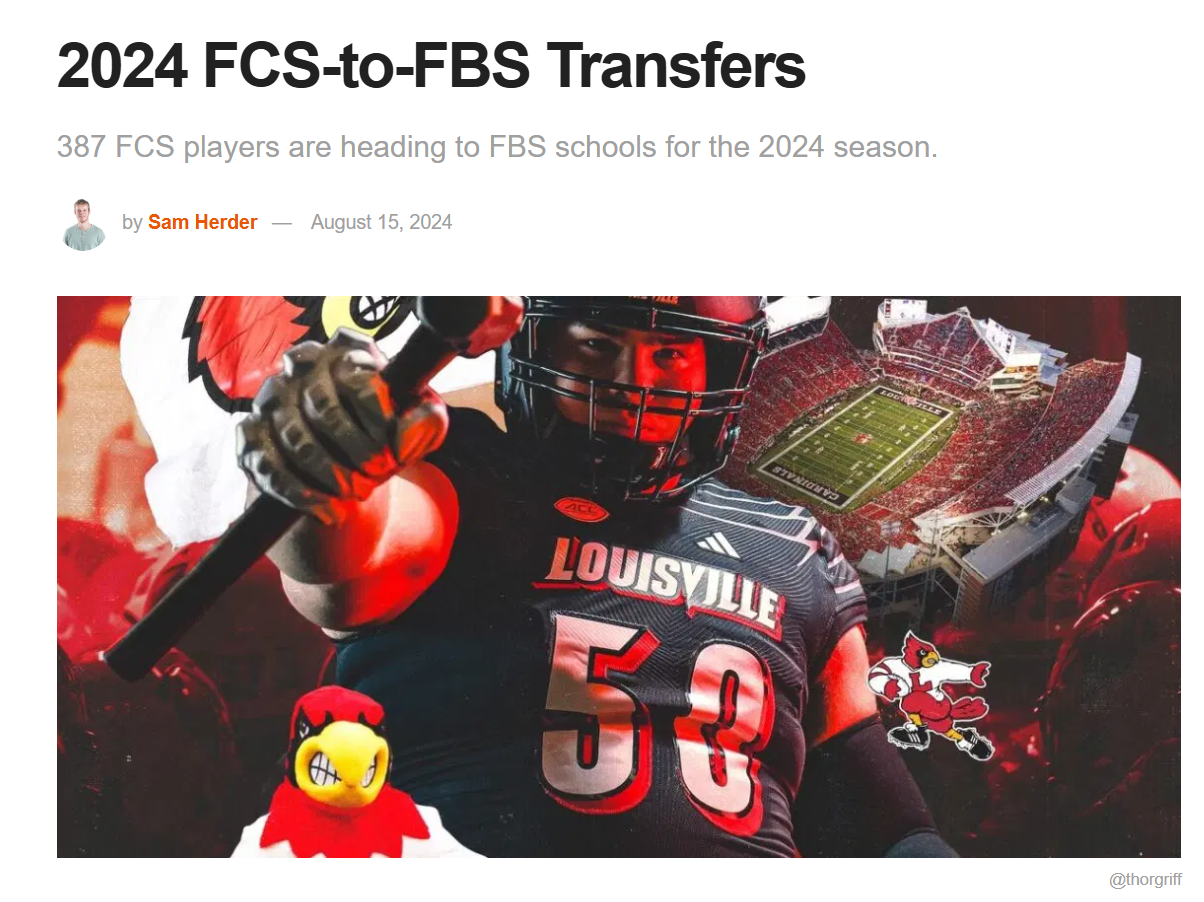 • HERO Sports - 2024 FCS to FBS Transfers
---
HBCU Football. Real Passion. Real History. Thee I Love ❤️
• HERO Sports - 2024 FCS to FBS Transfers
---
HBCU Football. Real Passion. Real History. Thee I Love ❤️
Share This Article
By SheLovesThee Podcast
